What are distractions?
Distractions are things that pull us away from what we intended to be doing—though sometimes we need those breaks too.
Despite such a simple definition, distractions are not so simple to avoid in the modern world.
What are some examples of distractions? On any normal day, you can be interrupted by a coworker, a buzz from an email, an unwanted phone call, or an Instagram notification telling you about all the likes your last post got.
Why does managing distractions matter?
These might seem minor in the moment, but distractions have a ripple effect beyond just the time they take up. There are two further issues associated with distractions:
1 | They continue to degrade your cognitive ability long after you are distracted. Let's say a coworker comes to you to have a chat. Afterwards when you try to get back to your work some of your attention remains stuck with the topic of the chat — a concept called 'attention residue'. The more distractions you experience, the greater the reduction in your cognitive capacity and performance that you can use for whatever you want to focus on in the present. One study found that after a big distraction it takes an average of 23 minutes and 15 seconds to get back to the task you were meant to be focusing on.
You have to completely shift your thinking, it takes you a while to get into it and it takes you a while to get back and remember where you were. — Gloria Mark
2 | Due to how fast we switch contexts on our phones, our brains are struggling to leave that environment for the much slower pace of real life. We end up forming bad habits which reduce our attention span, as our brains are actually looking for a distraction. A study of 7102 adolescents found a strong association between the inability to focus and spending over 60 minutes on a smartphone per day (based on a test for ADHD). Adults can likely cope with slightly more than this which is interesting to note given that the average person's smartphone use is around 2 hours and 55 minutes. This suggests many of us might benefit from more awareness around our phone time.
*Technically distractions can also develop internally but that's a whole different can of worms that we think deserves a separate topic (we'll tackle that in Part 6 — Self–Awareness).
Why do I get distracted so easily?
These days most websites and apps are designed to capture as much of your attention as possible—it's literally their business model. Ever since smartphones became mainstream in 2010 technology has become a bigger part of our lives — bringing with it more competition for our attention. The effect of this is so severe that even when not using it, if your phone is in the same room as you it can noticeably reduce your cognitive ability.
Managing distractions in our modern environment is genuinely challenging—and it's not your fault. Many apps are literally designed to be hard to put down. The good news? There are practical ways to tip the scales back in your favor.
How can you manage distractions better?
Here are some practical strategies that actually work:
1. Be more organised
It's easier to notice when you're getting distracted if you're clear on what you meant to be doing.
So if you haven't already, before you continue reading this, go have a quick read of Part 3 (Good Organisation) to brush up on your organisation skills. One incredibly useful tip is to schedule in when you want to be distracted (e.g. I only let myself scroll through twitter at 5pm on the train back from work).
2. Make your phone less distracting
There are countless opportunities to get distracted on your phone and to minimize the number of times you get distracted you really have to throw the kitchen sink at it.
- Turn off all notifications on your lock screen.
- Turn off notifications for the apps you don't need notifying you instantly (e.g. ask yourself: do you really need Messenger interrupting you while you're focused or is it ok to respond afterwards?)
- Consider which apps you could move to your laptop instead of having on your phone—maybe Instagram or Twitter? We get that deleting social media entirely isn't realistic (or even desirable) when your social life depends on staying connected. But having some apps only accessible on your computer can create just enough friction to help you use them more intentionally.
- If can't delete them, make distracting apps take longer to get to by moving them to a screen far away from the main home screen of your phone. This can help shake up habits and make the prospect of opening them slightly less appealing to your brain.
- Try to use search to open distracting apps rather than clicking on their icon. Typing is more of a conscious action than simply tapping an app icon, so you're less likely to be acting out of habit.
- If you find certain websites consistently pull you away from what you intended to do, blocking them during focus time can help.
- Setting app time limits can add helpful awareness—you'll at least see when you've hit your intended limit. They're easy to bypass if you really want to, but that moment of choice is the point.
- Learn to use Do Not Disturb frequently! The little ding or even the bzzz of a silenced phone can and often does completely kill your focus. If you need to occasionally have notifications turned on, then the easiest way to control them is by toggling this simple setting. One easy way to remember to turn it on is by using this habit stacking technique: after you look at your to-do list, turn your phone on Do Not Disturb.
- Another option is to reduce your phone's visual appeal. You can turn on a setting that makes your phone screen go Greyscale which is meant to cut down the times you pick up your phone by up to 35%. You could even try an ugly screensaver that might stop you from wanting to pick up your phone so much. It even so happens that if you schedule Do Not Disturb daily on iPhones it turns your lock screen black when the setting is on.
3. Make your computer less distracting
We won't go into too much detail here because it's much of the same as above.
- As with your phone, it's a good idea to turn off notifications & use Do Not Disturb as much as possible.
- Block distracting websites and use ad-blockers.
- Use social media feed blockers (such as News Feed Eradicator or DF Tube).
4. Be strategic about your dopamine
Quick context on dopamine: it's a neurochemical that makes us feel good in the moment, especially after unexpected rewards. Our phones and apps are incredibly good at triggering dopamine hits—which is why they can feel so hard to put down.
The challenge isn't that dopamine is bad—it's essential for motivation and pleasure. It's that the easy, constant dopamine hits from our phones can make everything else feel less appealing by comparison.
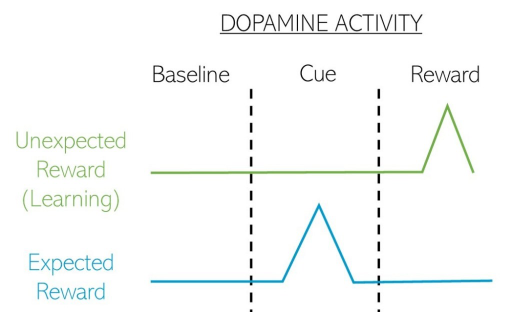
While dopamine feels good in the moment, it doesn't necessarily leave you fulfilled long-term. Apps are designed to be really good at triggering these dopamine hits—which is why they can feel so compelling even when we'd rather be doing something else.
i. Don't use your phone first thing in the morning.
Starting your day by scrolling through social media or email can set a pattern that's hard to break throughout the day. Your brain gets used to quick hits of stimulation, making it harder to settle into slower-paced, deeper work. If you can, try keeping your phone out of reach for the first 30-60 minutes after waking up. Some alternatives that might leave you feeling better:
- Have a glass of water / breakfast
- Exercise / stretch / go for a walk
- Sit outside and get some fresh air
- Read a book
- Listen to a podcast
- Meditate
- Write down some ideas you've had
- Have a shower
- Chat to your partner / family / friend
- Go straight into ~30 of focused work
ii. Taking breaks from high-stimulation apps
Taking occasional breaks from highly stimulating apps can be helpful. Here's what Dr. Greenfield says about 'digital detoxes':
"A digital detox means that you are temporarily ceasing the digital drugs, for a period of time. In and of itself, a digital detox doesn't really do anything except remind you what the possibility might be without that drug," he says. "If you do it long enough, it can change the neurobiological process a bit, but it has to be longer than a few hours or day, though. We're talking weeks or months to see real changes."
A week-long break can be refreshing, but what really makes a difference is building ongoing awareness into your daily routine. That's where small, consistent changes—like the ones we've covered—actually stick.
5. Avoid distractions in your workplace
i. Do your coworkers always interrupt you at bad times?
They probably don't realize you're in deep focus mode—a simple signal can help. Sometimes a simple cue like wearing headphones can be a sign for people to avoid you.
You could signal your intentions more literally by placing a sign on your desk saying something simple like:
Deep focus time—happy to chat after! Email me if it's urgent.
In the virtual world, you can and should set up an automatic text message reply to silenced calls. Here's a basic example:
Can't take calls right now—text me and I'll get back to you soon!
ii. Communicate asynchronously wherever possible
Real-time conversations are great when you need back-and-forth discussion or quick decisions. But they're not always necessary—and they can fragment your day pretty badly.
When possible, sharing updates via email or recorded video lets people engage on their own time (maybe even at 1.75x speed). This keeps everyone's focus blocks intact.
iii. Is your workplace noisy?
Whether you're working from a noise-polluted home or bustling office, sometimes noise can be a real distraction. Noise-cancelling headphones or earphones can be a nice way to cut it out.
We don't recommend you rely on these for long periods of time or against any manufacturers' advice, as you could potentially end up with hearing damage.
Coloured noises (brown, white and pink) are great at cutting out background noise even further. Listen to each and see which one you prefer.
Small changes add up here. Even just sorting your phone notifications this week is genuinely worth it.
 Try Unscroll